 Neel Thakkar

Small and mid-sized businesses (SMBs) are under increasing pressure to improve customer experiences, streamline operations, and scale efficiently in a competitive market. Traditional methods of managing customer relationships through spreadsheets, disconnected software, and manual processes are no longer sufficient for growing businesses. SMBs now need smarter systems that improve productivity, increase operational visibility, and support long-term growth.
This is why more SMBs are adopting Salesforce. Once considered mainly an enterprise CRM platform, Salesforce has evolved into a scalable solution for businesses of all sizes. With capabilities such as automation, reporting, AI-driven insights, and system integrations, Salesforce helps SMBs manage sales, customer service, and operations more effectively. In this guide, we’ll explore everything SMBs need to know about Salesforce CRM, including its benefits, implementation considerations, ROI potential, and long-term business value.
Why SMBs Need Smarter CRM Solutions?

- The business environment for SMBs has changed significantly in recent years. Customers now expect faster responses, personalized communication, and seamless experiences across every interaction.
- At the same time, businesses are facing increasing operational complexity, stronger competition, and growing pressure to make faster decisions using accurate business data.
- Many SMBs still rely on spreadsheets, outdated systems, or disconnected applications to manage customer information and daily operations. This often creates inefficiencies across different departments.
- As a result, businesses commonly face issues such as inconsistent customer communication, delayed reporting, limited visibility into sales pipelines, and duplicated data across systems.
- Manual administrative work and poor collaboration between teams also reduce productivity and slow down business growth for many SMBs.
- In addition, AI and automation are becoming essential parts of modern business operations. SMBs are now looking for CRM platforms that can improve efficiency while supporting long-term scalability.
- This shift is increasing the demand for smarter CRM solutions like Salesforce that can centralize operations, automate workflows, and help businesses scale more efficiently.
What Challenges Can SMBs Overcome with Salesforce?
Disconnected Customer Data
- Many SMBs struggle with customer information being stored across multiple tools, spreadsheets, and departments.
- This makes it difficult to track interactions, maintain data accuracy, and provide consistent customer experiences.
- Salesforce helps businesses centralize customer data into one unified platform, making information accessible to sales, support, and management teams.
Manual and Time-Consuming Processes
- Manual tasks such as updating spreadsheets, assigning leads, sending follow-up emails, and preparing reports consume valuable time and reduce productivity.
Salesforce automation capabilities help SMBs:
- Automate repetitive workflows
- Improve response times
- Reduce manual errors
- Increase operational efficiency
Limited Sales Visibility
Without proper CRM systems, SMBs often struggle to track:
- Lead progress
- Sales pipeline performance
- Revenue forecasts
- Team productivity
Salesforce provides real-time dashboards and reporting tools that improve visibility and support better business decisions.
Poor Customer Experience
- Slow communication and lack of customer history can negatively impact customer satisfaction and retention.
Salesforce helps SMBs deliver:
- Faster support responses
- Personalized interactions
- Better customer engagement
- Consistent communication across channels
Scalability Challenges
- As SMBs grow, their operational processes become more complex. Basic systems may no longer support increasing customer data, team collaboration, or advanced workflows.
- Salesforce provides a scalable platform that can grow alongside the business without requiring complete system replacement.
What Should SMBs Know Before Implementing Salesforce?

- Salesforce implementation requires proper planning and a clear understanding of business processes. Without a structured strategy, SMBs may face workflow inefficiencies, configuration issues, and operational confusion.
- Before implementation, businesses should identify their goals, operational challenges, and process requirements. This helps ensure that Salesforce is aligned with actual business needs rather than adding unnecessary complexity.
- Salesforce pricing can vary depending on user licenses, customization requirements, integrations, and ongoing support services. SMBs should evaluate both short-term implementation costs and long-term business value before investing.
- Although Salesforce may require an initial investment, it can deliver strong long-term ROI through automation, improved productivity, better reporting, and enhanced customer management capabilities.
- User adoption plays a major role in CRM success. Employees need proper onboarding, training, and support to understand how Salesforce improves their daily tasks and overall productivity.
- Even a well-designed CRM system may fail if teams are not actively using it. Businesses should focus on change management and employee engagement during implementation.
- Some SMBs try to implement too many custom features at the beginning, which can increase costs and create unnecessary system complexity. A phased and scalable implementation approach is usually more effective for long-term success with Salesforce.
What Are the Key Benefits of Salesforce CRM for SMBs?
1. Centralized Customer Data
- Salesforce helps SMBs manage customer information, sales activities, and service requests from one centralized platform instead of multiple disconnected systems.
- Teams can access customer records, interaction history, and opportunities from a single location, improving collaboration across departments.
- Centralized data also improves reporting accuracy, reduces duplicate records, and creates a more consistent customer experience.
2. Improved Sales Visibility
- Salesforce gives SMBs better visibility into sales pipelines, team performance, and revenue forecasts through real-time dashboards, reports, and analytics tools.
- Businesses gain better visibility into deal progress, conversion rates, and sales targets, helping managers make faster decisions.
- Real-time analytics also support more accurate forecasting and stronger sales strategies.
3. Customization Flexibility
- Salesforce allows SMBs to customize workflows, dashboards, reports, approval processes, and automation rules based on their business requirements.
- Businesses can configure the platform according to their operational processes without changing their entire workflow structure.
- This flexibility helps SMBs build CRM systems that align with their industry needs and long-term business goals.
4. Strong Integration Capabilities
- Salesforce integrates with ERP systems, accounting software, marketing tools, e-commerce platforms, and communication applications.
- These integrations help SMBs create a connected business environment with smoother data flow between systems.
- A well-integrated CRM setup improves efficiency, reduces manual work, and enhances operational visibility.
5. Automation and Productivity Improvement
- Salesforce helps SMBs automate repetitive tasks such as lead assignments, follow-ups, approvals, notifications, and workflows.
- Automation helps SMBs reduce repetitive tasks, improve accuracy, and increase operational efficiency across daily business processes.
- This allows teams to focus more on customer engagement, strategic tasks, and business growth.
Is Salesforce Worth the Cost for SMBs?
- For many SMBs, Salesforce can become a valuable long-term investment when implemented strategically. The platform helps businesses improve efficiency, visibility, and customer relationship management as operations grow.
- Salesforce is especially beneficial for SMBs managing increasing customer data and complex business processes. It helps businesses organize information more effectively while improving collaboration across teams.
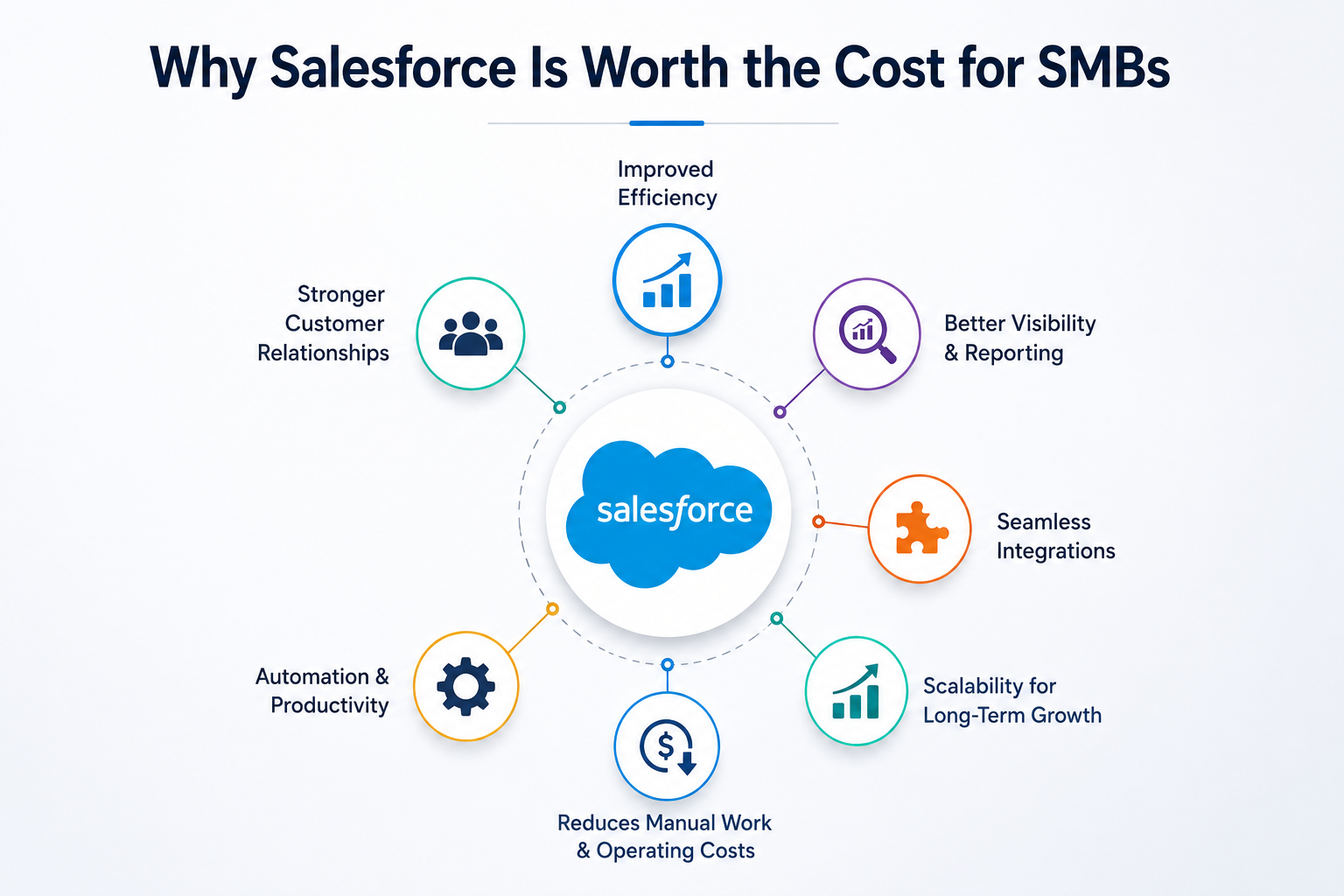
- Many SMBs invest in Salesforce to automate repetitive tasks and reduce manual workload. Automation helps improve productivity, save time, and streamline daily operations.
- Businesses looking for better reporting, forecasting, and sales visibility can also gain significant value from Salesforce. Real-time dashboards and analytics support faster and more informed decision-making.
- Salesforce is also useful for SMBs that require integrations with ERP systems, marketing platforms, accounting software, or other business applications. This creates a more connected and scalable operational environment.
- However, SMBs with very limited operational complexity or basic CRM needs may not require advanced Salesforce capabilities immediately. Businesses should evaluate whether the platform aligns with their current requirements and long-term growth plans.
- Instead of viewing Salesforce only as a software expense, SMBs should evaluate its value based on productivity improvements, reduced manual work, stronger customer engagement, improved sales visibility, and long-term business scalability.
How SMBs Can Maximize Salesforce ROI
- SMBs should start by defining clear business goals before implementing Salesforce. Identifying operational bottlenecks, sales process gaps, and customer management issues helps align Salesforce with actual business requirements.
- A successful Salesforce strategy should focus on measurable business outcomes such as improving productivity, increasing sales visibility, enhancing customer engagement, or reducing manual processes.
- SMBs should avoid adding excessive customizations or overly complex features during the early stages of implementation. Starting with essential functionalities makes the system easier to manage and improves overall user adoption.
- Keeping the implementation simple and scalable also helps reduce deployment risks, minimize operational disruptions, and lower long-term maintenance complexity.
- Employee training plays an important role in helping SMBs maximize the value and long-term ROI of Salesforce. Teams should clearly understand how to use the platform effectively and how it supports their daily responsibilities.
- User adoption improves significantly when employees understand the business value of Salesforce, including better productivity, faster workflows, and improved collaboration across teams.
- Working with an experienced Salesforce consulting partner can help SMBs build scalable CRM solutions, avoid costly implementation mistakes, improve deployment efficiency, and maximize long-term return on investment.

Which Salesforce Products Are Best for SMBs?
Sales Cloud
- Salesforce Sales Cloud is ideal for SMBs looking to improve lead management, opportunity tracking, sales forecasting, and overall pipeline visibility. It helps sales teams organize customer interactions and manage deals more efficiently.
- SMBs can use Sales Cloud to automate follow-ups, track sales activities, manage contacts, and gain real-time insights into sales performance. This improves productivity and helps teams close deals faster.
- The platform also provides dashboards and reporting tools that help business owners monitor revenue trends, sales targets, and team performance more effectively.
Service Cloud
- Service Cloud is designed for SMBs that want to improve customer support and case management processes. It helps businesses manage customer inquiries, service requests, and support interactions from a centralized platform.
- SMBs can use Service Cloud to provide faster response times, track customer issues efficiently, and improve overall customer satisfaction through better support experiences.
- Features such as case routing, knowledge management, automation, and omnichannel support help businesses streamline customer service operations while improving team productivity.
Experience Cloud
- Experience Cloud helps SMBs create customer portals, partner portals, and self-service platforms that improve collaboration and communication with external users.
- Businesses can provide customers with secure access to support resources, case updates, account information, and knowledge articles through personalized digital experiences.
- Experience Cloud is especially useful for SMBs looking to improve customer engagement, partner collaboration, and self-service capabilities while reducing support workload.
Marketing Cloud
- Marketing Cloud supports SMBs looking to automate marketing campaigns, improve customer engagement, and deliver personalized communication across multiple channels.
- Businesses can use Marketing Cloud for email marketing, customer journey automation, audience segmentation, campaign tracking, and targeted customer communication.
- The platform helps SMBs build stronger customer relationships through data-driven marketing strategies and more personalized customer experiences.
Field Service
- Field Service is useful for SMBs managing field technicians, service appointments, installations, maintenance tasks, or on-site customer support operations.
- The platform helps businesses schedule appointments efficiently, assign technicians, optimize routes, and track field operations in real time.
- Field Service also improves communication between field teams and office staff, helping SMBs deliver faster service and improve customer satisfaction.
When Should SMBs Consider Moving to Salesforce?

- SMBs should consider moving to Salesforce when customer data is spread across multiple spreadsheets, tools, or departments. Disconnected information often creates inefficiencies and makes customer management more difficult.
- Businesses that rely heavily on manual processes for lead tracking, reporting, approvals, and follow-ups may struggle to maintain productivity as operations grow. Automation becomes increasingly important at this stage.
- Inaccurate sales forecasting and limited visibility into pipeline performance are also signs that an SMB may need a more advanced CRM platform. Better reporting helps businesses make faster and more informed decisions.
- SMBs experiencing inconsistent customer follow-ups or communication gaps may benefit from centralized customer management and automated workflow capabilities within Salesforce.
- When generating reports becomes time-consuming and data analysis lacks accuracy, it often indicates that existing systems are no longer supporting operational efficiency effectively.
- Businesses facing operational complexity due to rapid growth may also require a scalable CRM platform that can support expanding teams, customer data, and evolving business processes.
- SMBs should also evaluate Salesforce when their current CRM systems or disconnected applications can no longer support integration requirements, automation needs, or long-term business growth plans.
How SMBs Can Ensure a Successful Salesforce Implementation
1. Aligning Salesforce with Business Goals
- SMBs should align Salesforce implementation with clear and measurable business objectives. Goals may include improving sales efficiency, increasing customer retention, reducing manual work, or enhancing reporting visibility.
- A CRM system should support overall business strategy rather than simply replacing existing tools. Businesses that connect Salesforce implementation with operational goals are more likely to achieve long-term success and higher ROI.
2. Importance of Proper Planning Before Implementation
- A successful Salesforce implementation begins with detailed planning and process evaluation. SMBs should understand their current workflows, operational bottlenecks, customer management processes, and reporting requirements before starting implementation.
- Businesses should also identify integration requirements, user expectations, automation opportunities, and scalability needs during the planning stage. A clear implementation roadmap helps reduce deployment risks and improves project efficiency.
- Proper planning also helps SMBs avoid unnecessary delays, configuration issues, and operational disruptions during implementation.
3. Avoiding Unnecessary Customization
- Many SMBs make the mistake of implementing excessive customizations during the initial phase. While Salesforce offers strong customization capabilities, overcomplicating the system too early can increase maintenance costs and reduce usability.
- SMBs should focus on essential features and business-critical workflows first. A simpler and cleaner CRM setup improves user adoption, reduces confusion, and creates a more scalable foundation for future enhancements.
- A phased implementation approach is often more effective because it allows businesses to expand system capabilities gradually based on operational growth.
4. Ensuring Smooth Data Migration and System Integration
- Accurate data migration is one of the most important parts of Salesforce implementation. SMBs should ensure customer records, sales data, and operational information are cleaned, validated, and properly organized before migration.
- Businesses should also integrate Salesforce with existing systems such as ERP platforms, accounting software, email tools, marketing platforms, and customer support applications. This creates a connected business ecosystem and improves operational efficiency.
- Poor data migration or disconnected systems can lead to reporting inaccuracies, duplicate records, and workflow disruptions after implementation.
5. Improving User Adoption Through Training
- Employee adoption plays a critical role in CRM success. Even a technically well-configured Salesforce environment may fail if employees do not actively use the system.
- SMBs should provide proper onboarding, hands-on training, and continuous support to help employees understand how Salesforce improves their daily work and productivity.
- Training should focus not only on system functionality but also on demonstrating the business value of CRM adoption across different departments.
6. Building a Scalable CRM Setup for Future Growth
- SMBs should design Salesforce environments that can support long-term business growth and evolving operational requirements. A scalable CRM setup helps businesses expand without needing major system redesigns later.
- As businesses grow, they may require additional automation, advanced reporting, new integrations, customer portals, AI capabilities, or multi-department collaboration features. Planning scalability early helps reduce future implementation complexity.
- A future-ready Salesforce setup allows SMBs to adapt more efficiently to changing market demands and business expansion opportunities.
Conclusion
SMBs today need more than basic customer management tools. Businesses require scalable, intelligent, and connected systems that can support growth, improve operational efficiency, and deliver better customer experiences. Salesforce offers SMBs a powerful CRM platform that combines automation, customization, analytics, integrations, and scalability into a single ecosystem.
However, Salesforce success depends on more than just technology. SMBs must approach CRM implementation strategically by aligning the platform with business goals, focusing on user adoption, and avoiding unnecessary complexity. When implemented correctly, Salesforce can become a long-term growth engine that helps businesses improve productivity, strengthen customer relationships, and scale confidently in a competitive business environment.